Finding AI Referrals in GA4: I Found One Session in Twelve Months (2026)
GA4 now has a native AI Assistant channel. Here is what it caught on a real site, what it structurally cannot catch, and why the published numbers look nothing like yours.
Every week there is another statistic about AI referral traffic converting better than Google, and a post telling you to go find it in your analytics. Almost none of them show you a real account.
Reading traffic reports is my job. I audit local businesses' marketing, and I build attribution tooling that sits on top of GA4, so I spend most of my week inside analytics accounts. In June I tore my own site down and rebuilt it from the ground up, wired the way I wire everything else: every link tagged, every number cross-checked through a second system. It is the cleanest data I own.
So here is the check all those posts tell you to run, run on a real account and opened all the way. Twelve months of Google Analytics, every session, no cherry-picking.
In 509 sessions over a year, exactly one came from an AI assistant. One. From ChatGPT. Zero from Perplexity, Claude, Gemini, or Copilot. It landed after the June rebuild, inside the site's first twelve weeks.
That single session had a 100% engagement rate against a site average of 44%, and spent 1 minute 51 seconds on the page against a site average of 28 seconds. So the quality claim in all those articles holds up. The volume claim does not.
The short answer
GA4 now assigns AI assistant traffic to a built-in channel group called "AI Assistant," so no custom regex is needed to see it. Open Reports, then Traffic acquisition, and search the table for chatgpt, perplexity, claude, gemini, or copilot. The channel only counts sessions that arrive carrying an AI referrer, and published research puts the share of AI traffic that arrives with no referrer at 70.6%, so whatever it shows you is a floor.
How do you find AI referral traffic in GA4?
Most of the advice on this is out of date. You no longer need a custom channel group or a regex, because Google built one.
Sometime before August 2026, GA4 added AI Assistant as a default channel group. It shows up next to Organic Social, Direct, Email and Organic Search with no configuration at all. If you have not looked at your channel report in a few months, it is probably sitting there already.
Here is the fastest way to check your own:
- Open Reports, then Acquisition, then Traffic acquisition.
- Set the date range wide. A month is not enough to see this channel on a small site, and that is the point. Use twelve months.
- Look for AI Assistant in the channel list.
- To see which assistants specifically, add Session source / medium as a secondary dimension, then use the table's search box and type
chatgpt, thenperplexity, thenclaude, thengemini, thencopilot, one at a time.
The source/medium values look like chatgpt.com / ai-assistant. That ai-assistant medium is Google's own labelling, which is what makes the channel work without you doing anything.
If you would rather not click through it, the same data is available in an Exploration with Session source / medium as the row dimension, which is easier to export. And if your marketing data already sits in one connected layer, this is a single query rather than a report you go and find, which is the difference between checking it once and watching it.
Now, what it shows.
What did I find on a real site?
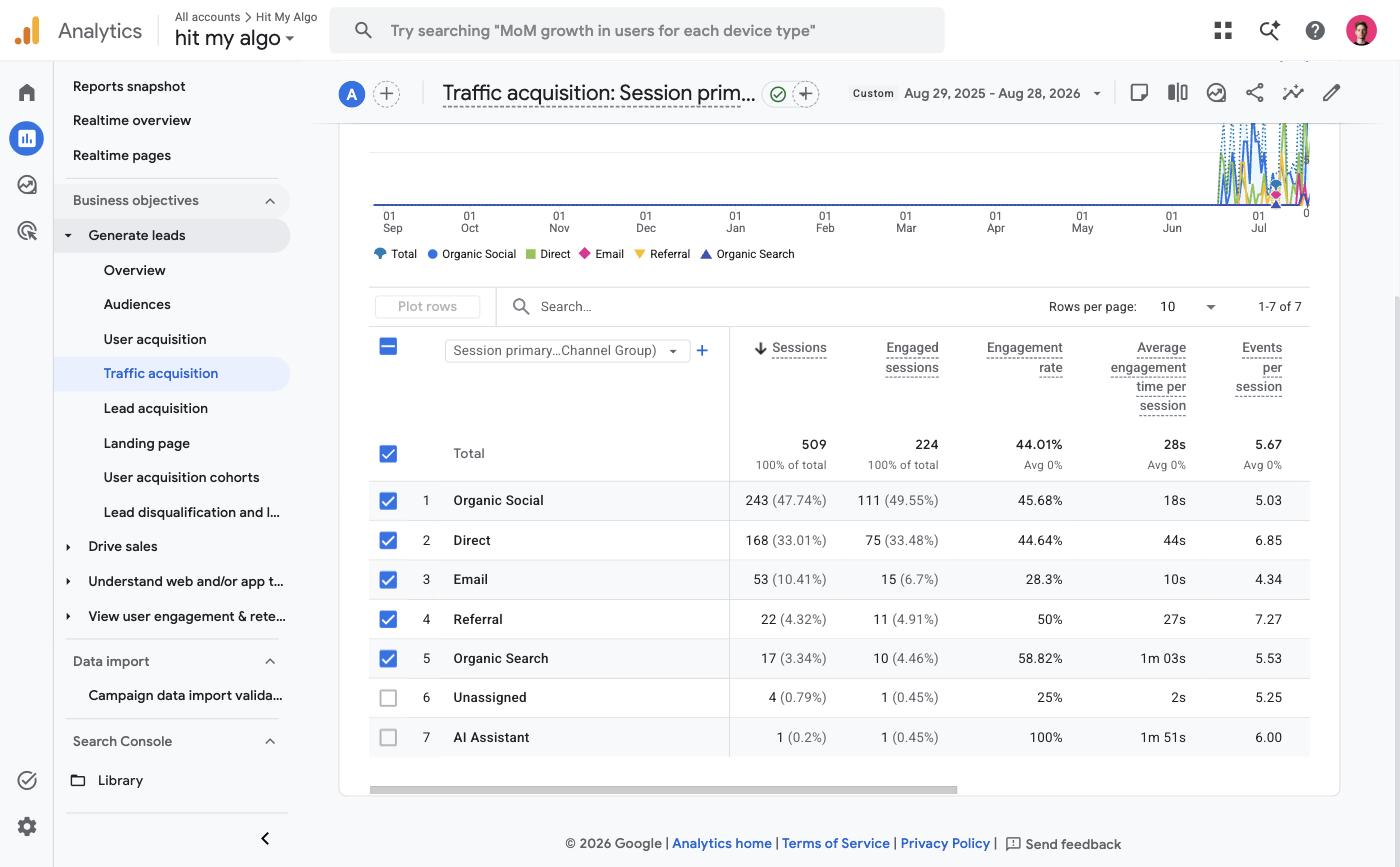
One session. Twelve months. 509 total sessions.
This is my own site, a small business marketing agency in the St. Louis area, from 28 August 2025 to 28 August 2026. One thing about that window before the table. The site in its current form is twelve weeks old. I rebuilt everything in June 2026, and nearly all of the year's sessions arrived after the relaunch, so a twelve-month report on this property is really the story of a brand-new site plus a quiet prehistory.
| Channel | Sessions | Share | Engagement rate | Avg engagement time |
|---|---|---|---|---|
| Organic Social | 243 | 47.7% | 45.7% | 18s |
| Direct | 168 | 33.0% | 44.6% | 44s |
| 53 | 10.4% | 28.3% | 10s | |
| Referral | 22 | 4.3% | 50.0% | 27s |
| Organic Search | 17 | 3.3% | 58.8% | 1m 03s |
| Unassigned | 4 | 0.8% | 25.0% | 2s |
| AI Assistant | 1 | 0.2% | 100% | 1m 51s |
| Total | 509 | 44.0% | 28s |
Searching the source/medium table one assistant at a time:
| Search term | Sessions |
|---|---|
| chatgpt | 1 (chatgpt.com / ai-assistant) |
| perplexity | 0 |
| claude | 0 |
| gemini | 0 |
| copilot | 0 |
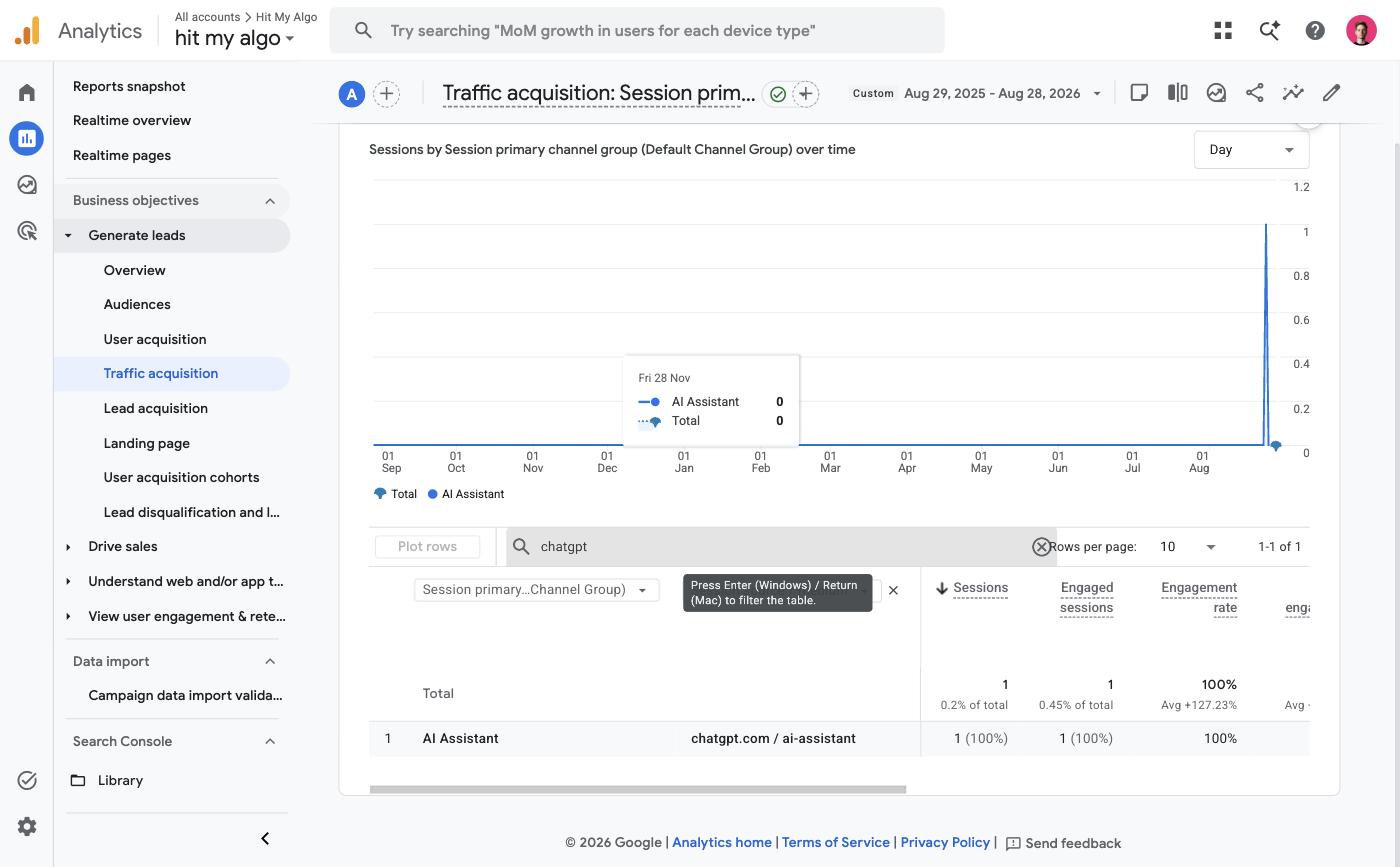
That one session engaged at 127% above the site average, which is GA4's own comparison figure, and stayed roughly four times as long as the average session.
It also produced zero key events and zero revenue.
This is a sample of one. One session cannot establish an engagement rate, a conversion rate, or anything else. Anybody presenting a single session as evidence that AI traffic converts better is doing something I am not going to do here. What the number can tell you is that the channel exists, that it is findable, and that on this site it is currently a rounding error.
The next question is whether one session is low.
Is one session in a year normal?
It is almost exactly the published benchmark, which surprised me.
Contentsquare put AI at 0.2% of total traffic in Q4 2025. My site, measured over the following twelve months, came in at 0.2%. Identical.
Conductor's benchmark, built on 35.7 million AI sessions across ten industries, puts the average at 1.08% of website traffic, ranging from 0.25% in Communication Services to 4.09% in the semiconductors subsector.
So depending on which benchmark you use, my site is either exactly average or roughly five times below average. Both readings are defensible, and the honest summary is that AI referral traffic is a small single-digit percentage of traffic at best, for most sites, right now.
One more benchmark worth knowing: Conductor found 87.4% of AI referrals come from ChatGPT. My one session came from ChatGPT. That is not evidence of anything on a sample of one, but it does mean that if you only ever check one assistant, check that one.
None of which explains the headlines. That takes a different number.
Why do the published conversion stats look nothing like this?
Because most AI traffic never identifies itself, and the numbers that make headlines are measured on the part that does not show up in this report.
The Digital Bloom's analysis found that 70.6% of AI traffic arrives with no referrer header. A session with no referrer cannot be assigned to the AI Assistant channel, because there is nothing to assign it from. GA4 files it under Direct.
So my AI Assistant number is not a measurement of how many people arrived from an AI assistant. It is a measurement of how many arrived and said so. The real figure is higher and cannot be known from this report.
It also explains the eye-catching conversion statistics. The same analysis reports 1.66% sign-up conversion from visible AI traffic and 10.21% from what it calls dark AI direct traffic. The impressive number is attached to traffic that, by definition, is sitting inside your Direct bucket unlabelled.
On my site, Direct is 168 sessions, a third of everything, and it carries every dollar of revenue GA4 recorded for the year, bearing in mind GA4 only sees payments taken on the site itself. On this property the payment processor recorded more revenue over the same year than GA4 attributed, because a payment that carries no campaign tag at checkout cannot be tied back to a visit. I cannot tell you how much of that is AI referred. Nobody can tell you that about their site, and anyone who says otherwise is estimating.
So the practical position is this. The AI Assistant channel gives you a floor, and it is a real floor and worth watching. Direct is where the ceiling hides, and no amount of GA4 configuration opens it up.
Which leaves a more useful question than "how do I measure it."
Why does this site have almost no AI traffic?
Because the site is twelve weeks old, and AI assistants recommend what they can already find.
Search authority is the slowest asset in marketing. A rebuilt site earns it from zero no matter how well it is built, and twelve weeks is nothing on that clock. Organic Search delivered 17 sessions across this window. The traffic engine in the meantime is social, on purpose: nearly half of everything came from Organic Social, because social is the one channel a new site can win in its first quarter.
That is the finding, and it is more useful than the AI number itself. AI assistants read the sources that already exist: the indexed pages, the directories, the reviews. A site that is new to search is new to them too. You cannot harvest referrals from AI assistants before you exist in the sources they read, and the newest site in town starts at zero with them no matter how good it is.
The two numbers that matter are next to each other in the same report, and the small one explains the smaller one.
Worth noticing too: Organic Search had the second-highest engagement rate on the site at 58.8%, and by far the longest sessions at 1 minute 3 seconds, more than double the site average. Seventeen sessions, and they behaved better than the 243 from social. The channel is small because the site is young, not because the channel is weak.
What should you do about it?
Check it, write the number down, and then go work on the thing upstream of it.
Pull your own number today. Twelve-month window, Traffic acquisition, look for AI Assistant. It takes two minutes and now you have a baseline. Contentsquare measured 632% year-over-year growth in AI-referred traffic, so a channel that is a rounding error today is worth a dated baseline.
Do not build a strategy on a sample this small. If your AI Assistant channel shows single-digit sessions, it cannot tell you what content AI assistants like, which pages they cite, or whether that traffic converts. It can only tell you the channel is switched on.
Treat Direct as a known unknown, not as a number. A third of my traffic and all of my recorded revenue sits in a bucket that certainly contains some AI referrals and some direct visits and some stripped referrers from elsewhere. Reporting it as "direct visitors who typed the URL" is a story, not a measurement.
Then go look at your search presence, because that is what gates the channel you were trying to grow.
One AI session in a site's first quarter is not a failure. It is a baseline, honestly measured, on a channel most people are describing without having checked their own. Get yours, date it, and check again in ninety days.
The checklist our paid audit runs is published in full. All 160 checks, website to AI readability, free, no email, no gate. Run them on your own business, or have us run them and write the plan: The Blueprint.
Frequently asked questions
How do you find AI referral traffic in GA4?
Google built a default AI Assistant channel group, so you no longer need a custom channel or a regex. Open Reports, Acquisition, Traffic acquisition, set the primary dimension to Session primary channel group, and look for AI Assistant. It takes about two minutes.
Do you still need a custom regex for AI traffic?
No. Most advice on this is out of date. The built-in channel catches sessions arriving with an identifiable AI referrer, in the source and medium form chatgpt.com / ai-assistant.
Is a single AI session in a year normal for a small site?
It sits close to the published benchmarks. Contentsquare measured AI at 0.2% of total traffic in Q4 2025, and Conductor put it at 1.08% across ten industries. One session out of 509 is 0.2%.
Why do published AI conversion stats look nothing like this?
Because most AI traffic never identifies itself. The Digital Bloom found 70.6% of AI traffic arrives with no referrer header, which means it lands in Direct. The headline conversion numbers are measured on the visible slice, and the invisible slice is larger.
What should you do if your AI channel shows almost nothing?
Write the number down with today's date, then go work on the thing upstream of it. A single-digit count cannot tell you what content AI assistants like or whether that traffic converts. It can only tell you the channel is switched on, which makes it a baseline rather than a strategy.
Method
Property. A single Google Analytics 4 property for a small B2B marketing agency site in the St. Louis area, my own. The site was rebuilt from the ground up in June 2026 on the same property, and nearly all sessions in the window arrived after the relaunch. Not a client property, and no client data appears here.
Window. 28 August 2025 to 28 August 2026, twelve months. A 28-day window was also checked and returned the same single AI session.
Report. GA4 Reports, Acquisition, Traffic acquisition, primary dimension Session primary channel group, secondary dimension Session source / medium. Every figure was then independently re-pulled through a second system querying the same GA4 property, which returned the identical single session under chatgpt.com / ai-assistant with zero conversions, over the twelve-month window and over the post-relaunch window alone, which is how the session is placed after the rebuild. Figures are as GA4 reported them on 29 August 2026, when the report was re-pulled and screenshotted. Between the first pull on 28 August and that re-pull, late-arriving data nudged the year's totals from 505 sessions to 509. The AI Assistant count did not move. Comparison percentages against the property average are GA4's own calculations, not mine.
Assistant search. The source/medium table was searched separately for chatgpt, perplexity, claude, gemini and copilot. Only chatgpt returned any sessions, as chatgpt.com / ai-assistant.
Known limits, and they are large. One session is not a sample. No engagement, conversion or revenue conclusion can be drawn from it and none is drawn here. This is one small, twelve-week-old site with deliberately social-weighted traffic, so it is a worked example of the method rather than a benchmark for anyone else. The AI Assistant channel counts only sessions arriving with an identifiable AI referrer, so it understates true AI-referred traffic by an unknown amount. GA4 also undercounts arrivals generally, through ad blockers, tracking prevention and in-app browsers that drop the referrer.
External benchmarks cited. Contentsquare (0.2% of total traffic from AI in Q4 2025, 632% year-over-year growth). Conductor (1.08% average across ten industries, 87.4% of AI referrals from ChatGPT, from a benchmark of 35.7 million AI sessions). The Digital Bloom (70.6% of AI traffic lacking referrer headers, 1.66% conversion from visible AI traffic, 10.21% from dark AI direct traffic). These are third-party figures, reproduced as published, and were not independently verified.
Data pulled 28 August 2026. This article is refreshed as the channel grows.
Sources
- Demand Local, AI Referral Traffic Conversion Rate Statistics: https://www.demandlocal.com/blog/ai-referral-traffic-conversion-rate-statistics/
- AirOps, AI Referral Traffic vs Organic Search: https://www.airops.com/blog/ai-referral-traffic-conversion-rates